Fermented Daikon Recipes
2 recipes, kitchen science with citrus seeds, Open Kitchen, Sunday, Feb 26, at 1 pm PST and Zoom link (scroll to bottom of this post)
So, I know I said that I moved on to D and daikon, but I couldn’t help sneaking another citrus recipe in for you with the addition of grapefruit. 🙊 As I mentioned I am somewhat obsessed with fermenting citrus at the moment. Do you go through fermentation phases? (Let me know in the comments.)
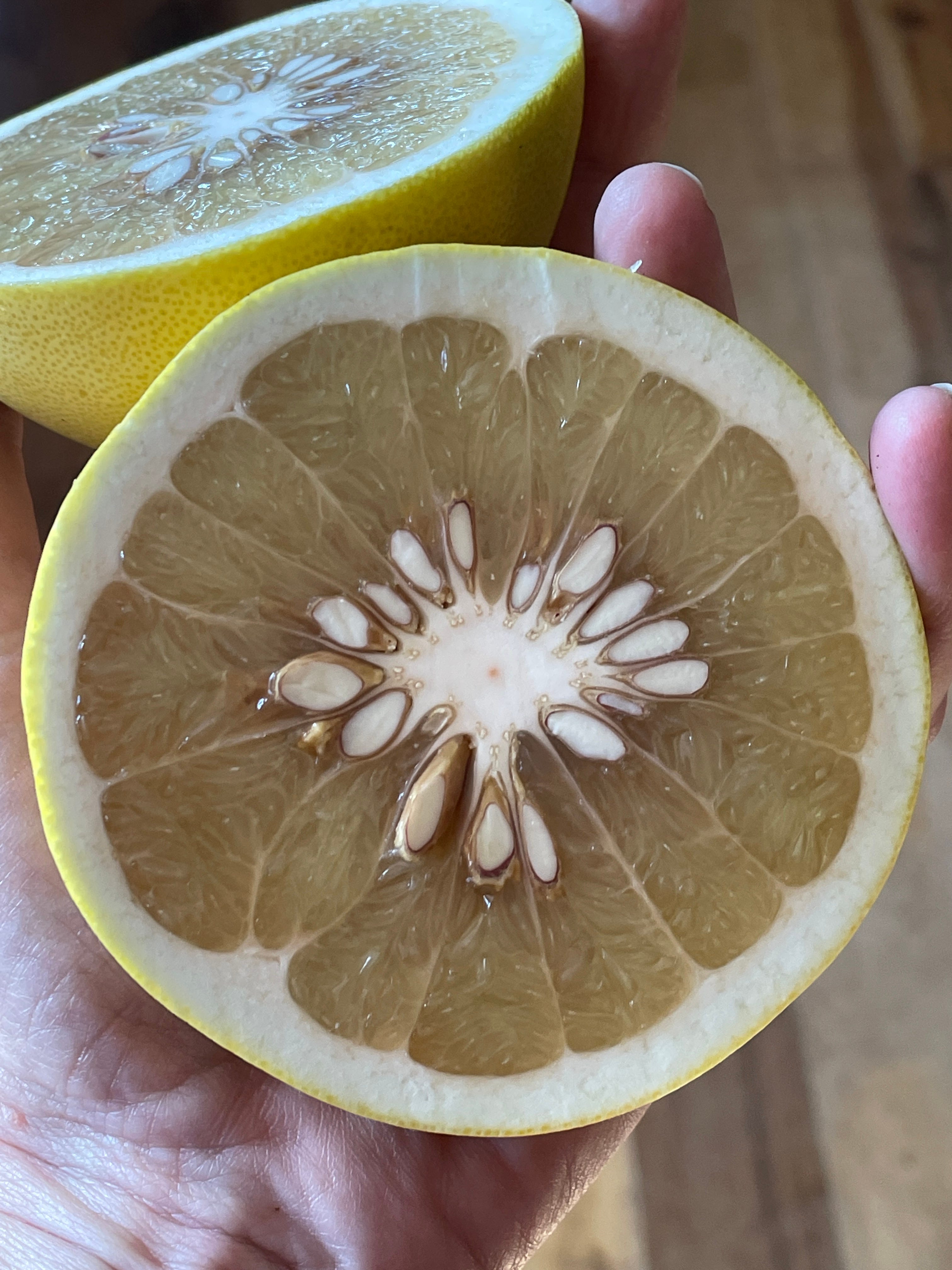
Anyway, I did a little research on pectins in citrus. I’d casually noticed for a few years that when I left the seeds in preserved lemons, for example, the brine would gel up. From my canning years, oh so! long ago, I knew that citrus was a good source of pectin but I didn’t explore this further until last week when I was motivated by one of your comments on a post.
It turns out that both the peels and the seeds are high in pectin. The peels of fresh fruit are remarkably higher than that one that has been in cold storage for months. This is one reason you may notice that a particular citrus ferment can develop more or less gel in the brine. The other is the seeds. You will find when you leave them in your ferment (as I did), the ferment will thicken. For condiments, and recipes like the one below, I tend to take the seeds out because I don’t want anyone to chomp into a seed by accident. However, when I make simple salt-preserved citrus I always leave them in. I like the gelatinous quality. Since I know I will be dicing it up before I use it, I know I will remove the seeds then.
For some fun kitchen science, place a tablespoon or so of fresh citrus seeds in a jar, and cover with a bit of water overnight. The next day you will see they’ve created gel. You can add this gel to any preserve. In the same vein, I have started to experiment with adding fresh citrus seeds, tucked into a cheesecloth bundle, to non-citrus fermented condiments to thicken them up. I will keep you posted.
Back to our regularly scheduled programming. I’ve scheduled this month’s open kitchen. Sunday, Feb. 26 at 1 pm Pacific Time. (Scroll past the recipe to the link at the end of this email.) I realize this time is either great or impossible for some of you. I would love to hear your thoughts on times that work. I will be trying a number of different days of the week and times to try to offer the opportunity to many of you.


Rosemary Grapefruit Daikon Spirals
Makes 1 quart
The spirals give this fermented salad panache and character however you don’t have to have a spiralizer to enjoy the surprising flavors this recipe offers. Use a mandolin or knife to slice radishes very thinly or julienne instead.
This salad is a simple combination of winter and early spring ingredients and makes sure every taste sensor on your tongue has something to do. The daikon is fresh, crispy, and sours deliciously and a little salty with fermentation. The rosemary pairs nicely with both the daikon and the grapefruit and surprises the palate with its lovely bitterness. This bitterness comes from the chemical naringin. While it is present in all grapefruits it is higher in the white-fleshed old-school grapefruits that are harder to find than they used to be, since most people prefer sweet to bitter. However, the bitter element in foods is good for our kidneys. In this recipe I use pink grapefruit, it is easier to find, and while it is less bitter it is beautiful, and that pink color adds the antioxidant lycopene to the mix.
For an earthy spiced variation, you can substitute a tablespoon of freshly grated ginger for the rosemary.
1 pound daikon radish, white, green, or purple (or all three), peeled and spiralized
Some sprigs fresh rosemary, about a tablespoon finely chopped
1 ½ grapefruits, pink, red, or white
2 teaspoons (14 g) salt
Prepare the daikon and rosemary and place in bowl.
Prepare the grapefruit by cutting off both ends so that you’ve cut off the peel. Then cut the fruit into three sections crosswise. Carefully cut around the edges to remove the peel. The edges of the grapefruit will be exposed. Working over the bowl of radishes (so that all the juice goes in the ferment) take out the triangles of fruit by removing the membranes and dropping them into the bowl.
When finished add the salt and stir it in. You will have plenty of briny liquid almost immediately.
Put the daikon grapefruit mixture in your favorite fermentation vessel. If you don’t have one, press into a quart mason jar pressing out air pockets as you go. Wipe any excess off the sides of the jar with a clean cloth or paper towel. If you have small weights you can put them on the ferment or see the tip below. Screw a lid tightly on the jar.
Put this in a corner of the kitchen to cure. If the lid starts to bulge up, loosen the lid for a moment to “burp” the ferment and then tighten immediately. This will allow the oxygen to escape while the heavier CO2 stays in the jar helping to keep the process anaerobic. Watch for air pockets forming in the radish grapefruit mixture. If you see them, open the lid and press the it back down.
Allow to ferment on your counter for 5–10 days, burping regularly. During storage, the less airspace above a ferment, the longer it will last, so fill the jars to the rim and transfer the ferment to smaller jars as you use it. This ferment will keep, refrigerated for 6 months.
*Note: Zero waste tips: The spiralizer will leave you with a radish core. Wedge the cores crisscross over your mixture, tucking them under the shoulder of the jar. This will help keep everything in place (instead of a weight) and will be tasty to eat when finished.
Since this recipe leaves an extra half of grapefruit. Go ahead and enjoy it. It’s good for you and you’ll want to after putting together the ferment that you can’t eat for a few days.
Cubed Spring Radish Kimchi
Makes a little less than 1 quart
This recipe is based called Kkagdugi, common traditional kimchi. Kkadgugi is usually made with Korean radishes, which are much like a daikon. I have enjoyed this type of ferment with a variety of radishes. The large daikon should be cut into cube shapes; small round radishes make little half moons.
1 1/2 pounds (680 g) daikon, quartered if thin, cubed if large
1 1/2 teaspoons (12 g) unrefined fine salt
1/3 cup gochugaru (Korean red pepper powder), or 1–2 Tablespoons hot chile flakes
3 scallions, sliced crosswise in ½ in pieces, including green
3–4 cloves garlic, minced
½ teaspoon (2 g) sugar, preferably unrefined
Optional: 2 teaspoons (8 g) dried baby shrimp, crumbled
Variation: When fresh radish tops are available it is wonderful to add in a few of the tops, minced. Watercress is a traditional addition. Add about ¼ cup of chopped greens.
Prepare the daikon, add salt and pepper powder, and mix until coated. Massage a bit to help the brine begin to form. Set aside.
Prepare the remaining ingredients and add them to the mixture. If using dried shrimp, crush the shrimp to create a powder and add. Massage the entire mixture. Taste; add salt if needed. You should be able to taste the salt (like a chip) but it should not be overpowering. You should have a brine developing.
Follow the instructions for putting the kimchi mixture in your favorite fermentation vessel. If you don’t have one, put the mixture into a quart mason jar pressing out air pockets as you go. Wipe any excess off the sides of the jar with a clean cloth or paper towel. If you have small weights put them on ferment. Screw a lid tightly on the jar.
Put this in a corner of the kitchen to cure. Watch for air pockets forming in the kimchi. If you see them, open the lid and press the kimchi back down. If the lid starts to bubble up, simply open the lid for a moment to “burp” the ferment. Remember, this process is anaerobic.
Allow to ferment for 10–14 days. During storage, the less airspace above a ferment, the longer it will last, so fill the jars to the rim and transfer the ferment to smaller jars as you use it. This ferment will keep, refrigerated for 6 months.
Topic: Kirsten's Open Kitchen
Time: Feb 26, 2023 01:00 PM Pacific Time (US and Canada)
Join Zoom Meeting
https://us02web.zoom.us/j/89934953183?pwd=WldKWjZNSHVaelpOZGV1TWpUMlZ5QT09
Meeting ID: 899 3495 3183
Passcode: 383330
One tap mobile
+12532158782,,89934953183#,,,,*383330# US (Tacoma)
+13462487799,,89934953183#,,,,*383330# US (Houston)
Dial by your location
+1 253 215 8782 US (Tacoma)
+1 346 248 7799 US (Houston)
+1 669 444 9171 US
+1 669 900 9128 US (San Jose)
+1 719 359 4580 US
+1 253 205 0468 US
+1 309 205 3325 US
+1 312 626 6799 US (Chicago)
+1 360 209 5623 US
+1 386 347 5053 US
+1 507 473 4847 US
+1 564 217 2000 US
+1 646 558 8656 US (New York)
+1 646 931 3860 US
+1 689 278 1000 US
+1 301 715 8592 US (Washington DC)
+1 305 224 1968 US
Meeting ID: 899 3495 3183
Passcode: 383330
Find your local number: https://us02web.zoom.us/u/kcZBt3NBDZ


